
Introduction: From Idea to First Dollar
If you want to Build AI Micro-SaaS products that actually generate revenue, you must realize that most people don’t fail because they lack ideas—they fail because they overbuild and never launch
The dream of owning a software company used to require a Computer Science degree, months of coding, and thousands of dollars in capital.
In 2026, that barrier is gone.
Welcome to the era of the Build AI Micro-SaaS movement: single-purpose tools that solve one painful micro-problem for a very specific audience. By combining AI (logic) + No-Code tools (execution), you can go from idea on Friday night to your first paying user by Sunday evening.
“This guide serves as a step-by-step, execution-first blueprint—not just theory—and functions as a core component of our Passive Income with AI: The Ultimate 2026 Playbook, where we dive deeper into the broader strategy of building automated wealth.”
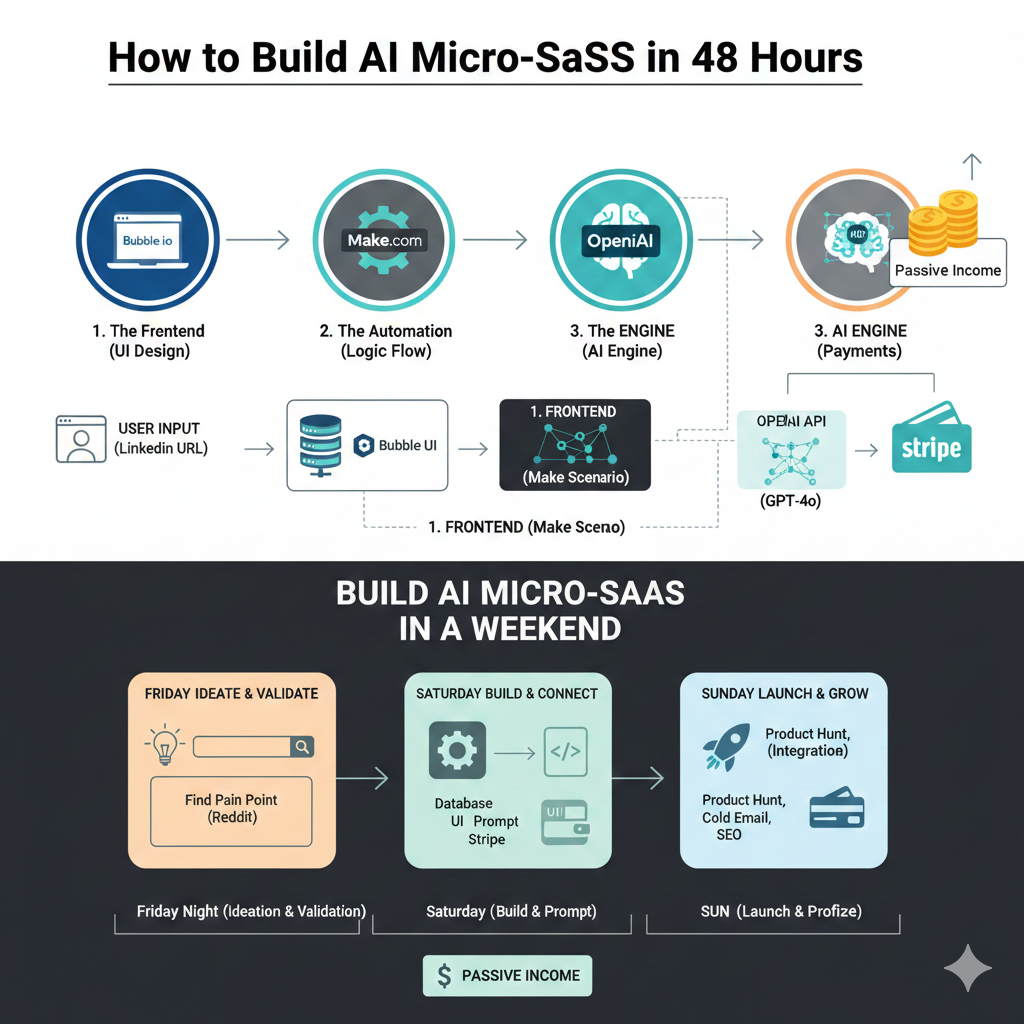
Part 1: Top 5 High-Value AI Micro-SaaS Ideas for 2026
Before you Build AI Micro-SaaS tools, you need a mission. These niches are urgent and monetizable:
1. The “Niche Compliance” Auditor (AI for Legal & Medical Firms)
Upload documents → AI checks compliance with updated 2026 data privacy regulations.
Why it works: Fear + regulation = high willingness to pay.
2. The “Programmatic SEO” Architect (AI for Bloggers & Agencies)
Input one keyword → generate 500 semantic clusters + full article outlines.
Target market: SEO agencies, niche site builders, affiliate marketers.
3. The “Video-to-Viral” Engine (AI Repurposing Tool for Creators)
Paste a YouTube or TikTok link → get:
- LinkedIn carousel copy
- X (Twitter) thread
- Short-form captions
Why it sells: Creators hate repurposing content manually.
4. AI “Cold Outreach” Personalizer (Sales & Lead Gen)
Paste a LinkedIn Profile URL → AI scans activity and writes a human-like opening line.
This will be our build example.
5. The “Expert Brain” API (Monetizing Knowledge)
Professionals upload reports/books → clients pay to consult an AI version 24/7.
Scales expertise without more time.
Part 2: The No-Code Technical Stack (2026 Modular Setup)
To Build AI Micro-SaaS fast, tools must talk to each other:
Core Stack
- Frontend (UI): Bubble.io
- Automation (Glue): Make.com
- AI Engine: OpenAI API (GPT-4o)
- Payments: Stripe
Optional (But Powerful)
- Transactional Emails: Postmark or SendGrid
- Stripe Alternative: LemonSqueezy (simpler taxes for solo founders)
Part 3: Step-by-Step Implementation (Cold Outreach Tool)
Step 1: Database Setup (Bubble.io)
Create a Data Type called: Outreach_Task
Fields:
LinkedIn_URL(text)Personalized_Hook(text)is_Processed(yes/no)
Step 2: User Interface (UI)
- Input box → “Enter LinkedIn Profile URL”
- Button → “Generate Hook”
- Text element → Displays
Personalized_Hook
Step 3: Automation with Make.com
Scenario Flow:
- Webhook (receives LinkedIn URL)
- OpenAI module → Chat Completion
- System Prompt: You are a world-class sales expert. Write a single human-sounding opening line based on this profile.
- Webhook response → Send output back to Bubble
Step 4: Payments & Access Control
- Install Stripe plugin
- Charge $10 for credits
- Condition: Button only works if
User Credits > 0
Part 4: Pricing Your AI Micro-SaaS (❗ Critical)
Simple Pricing Framework
- $9–$19/month: Saves time
- $29–$49/month: Makes or protects money
- Credit-based pricing: Heavy AI usage
Rule: Price on value delivered, not API cost.
Part 5: Unit Economics (Avoid Silent Failure)
Typical Monthly Costs
- OpenAI: $0.002 – $0.01 per task
- Bubble: ~$29
- Make.com: $9–$29
- Stripe fees: ~2.9%
🎯 Golden Rule:
Each customer must generate at least 5× their AI cost.
Part 6: Validation Before You Build (Pre-Sell Hack)
Don’t build first.
Do this instead:
- Create a landing page (Framer / Carrd)
- Add pricing + “Buy Now”
- Share it in niche communities
👉 If 5 people pre-pay → build it
👉 If not → pivot
This single step saves weeks of wasted effort.
Part 7: The 48-Hour Execution Roadmap
Friday Night – Validation (2 Hours)
Search Reddit & forums:
- “How do I…”
- “I hate doing…”
Manual pain = opportunity.
Saturday – Build (10 Hours)
- Morning: Database + UI
- Afternoon: Prompt engineering (your secret sauce)
- Evening: Stripe integration
⚠️ Reality Check:
If this is your first build, expect 60–72 hours, not 48.
Sunday – Launch (8 Hours)
- Landing page focused on one benefit
- Soft launch on Product Hunt & IndieHackers
- Cold outreach to 50 prospects (using your own tool)
Part 8: Security, Privacy & Abuse Prevention
Don’t ignore this.
- Rate limiting (daily usage caps)
- Simple CAPTCHA
- Auto-delete user data after processing
Add a clear Data Deletion Policy to build trust.
Part 9: First 100 Users Growth Plan
Keep it simple:
- IndieHackers launch
- Cold outreach (prove dog-fooding)
- One viral X thread showing results
- Programmatic SEO pages
Part 10: Critical Pitfalls to Avoid
- Feature creep: Solve one problem perfectly
- Unmonitored API usage: Set hard limits
- Copyright confusion: User owns AI output
Part 11: Who This Guide Is NOT For
This guide is not for you if:
- You want overnight riches
- You hate user feedback
- You want to build “the next Facebook”
Micro-SaaS is about focus, speed, and leverage.
Conclusion: Becoming the Architect of Your Income
In 2026, you don’t need to code to own software.
You need to design systems.
The first dollar you earn while you sleep isn’t magic —
it’s proof that you built something useful.